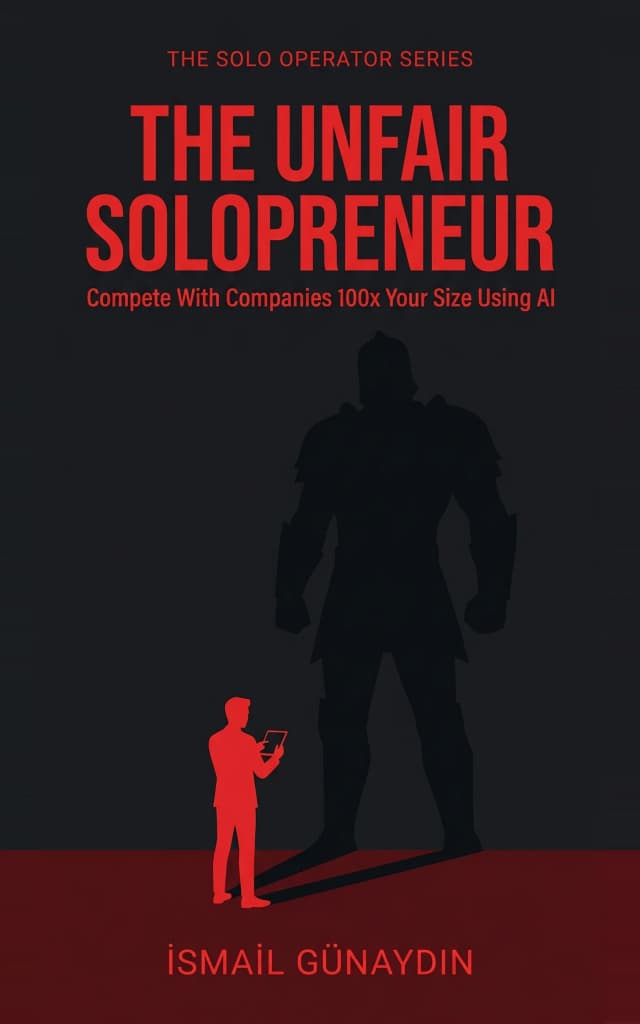
The Unfair Solopreneur: How to Compete With Companies 100x Your Size Using AI
You are not the underdog. You just think you are. Discover the five structural moats that enterprise corporations cannot duplicate without breaking their business model—and how autonomous AI turns you into an unstoppable market force.
İsmail GünaydınAuthor & Founder
The Solo Operator Series • Primary Research: U.S. Census Bureau, Gallup 2025 Trust Index, MIT AI Labs

The Unfair Solopreneur: Compete With Companies 100x Your Size Using AI
“You are not the underdog. You just think you are. A company a hundred times your size has more people, more budget, and more meetings. What it does not have is your speed, your face, or your freedom to care about one customer at a time. Those are not consolation prizes. They are structural advantages a big company cannot copy without ceasing to be a big company.”
Americans trust small businesses at about 70% and big business at about 15% (Gallup, 2025). That 55-percentage-point trust gap is an edge you already hold. When you fuse that intrinsic human trust with autonomous generative AI, the competitive landscape flips on its head.
How Can a Single Person Out-Compete an Enterprise Conglomerate?
- 1.The Decision Velocity Asymmetry: A 500-person enterprise operates under Metcalfe’s law of communication overhead—requiring product requirement documents, compliance reviews, and multi-department alignment meetings. A solo operator identifies customer pain at 9 AM, builds with AI by noon, and ships to production by 4 PM.
- 2.The 55-Point Trust Dividend: Gallup’s 2025 confidence metrics reveal that 70% of citizens trust small operators, while only 15% trust corporate giants. You are a real human with a face and direct accountability; enterprise is an anonymous logo hiding behind ticket queues.
- 3.The Microniche Economic Blindspot: Public corporations require $10M+ Total Addressable Markets (TAM) to justify departmental allocation. A solopreneur can build a cash-flowing $300k–$800k/year empire owning a hyper-specialized niche that enterprise product managers are forbidden from touching.
- 4.Department-Level Firepower: Generative AI disproportionately empowers the least-resourced operators (U.S. Census Bureau, 2025). One person leveraging AI writing, code agents, and local workflow automations matches the output of a 10-person agency without the payroll liability.
- 5.Actionable Execution: Every chapter of The Unfair Solopreneur ends with a single-page operational tool—from the 15-minute Advantage Audit to the 90-Day Build roadmap.
1. The Giant's Dilemma: Why Enterprise Scale Has Become a Liability
For decades, business school orthodoxies preached that bigger is always safer. More capital meant deeper moats. More employees meant greater market dominance.
That calculus was true when building a company required owning physical factories, buying warehouse inventory, and maintaining nationwide distribution fleets. Today, software is lightweight, distribution is algorithmic, and intelligence is available on-demand via an API.
In this new paradigm, enterprise scale is no longer an insurmountable moat. It is an anchor. Consider what happens inside an enterprise with 500 employees when a customer requests an urgent feature:
- • Customer requests a critical niche integration.
- • Request logged in Jira; prioritized for Q3 backlog review.
- • Product manager writes 22-page PRD; sets alignment meeting.
- • Legal assesses GDPR, CCPA, and vendor compliance risks.
- • Engineering estimates 6 sprints; executive sponsor leaves company.
- • Result: Feature delayed 9 months; customer churns.
- • Customer emails founder directly about the bottleneck.
- • Founder chats with customer for 10 minutes on phone/DM.
- • Founder prompts AI agent; drafts API route & UI component.
- • Runs local unit tests, validates with character & word checkers.
- • Ships update to production by 4:30 PM same day.
- • Result: Customer becomes ecstatic lifelong advocate.

2. The Five Edges That Sharpen When You Stay Small
In The Unfair Solopreneur, author İsmail Günaydın introduces the foundational thesis that defines the new solo economy:
“The advantages of the solopreneur are not temporary workarounds until you can afford to hire 50 people. They are permanent, structural edges that evaporate the moment you introduce organizational hierarchy.”
You Ship While They Schedule the Meeting
In a 100x company, 80% of human energy is expended on internal coordination—persuading coworkers, placating managers, and managing cross-departmental politics. As a solopreneur, your coordination cost is exactly zero. When you have an idea, you build it. When a market shift occurs, you pivot before their first committee has drafted an agenda.
You're a Person, They're a Logo
Consumers and B2B buyers are exhausted by corporate euphemisms, faceless PR statements, and automated support mazes. Americans trust small business at about 70% and big business at about 15% (Gallup, 2025). When customers buy from you, they know who built the product and who stands behind it. Your personal reputation is an un-falsifiable badge of authenticity.
Own the Slice Too Small for Them to Bother With
Enterprise unit economics collapse in specialized submarkets. An enterprise cannot afford to deploy a $300k engineer to solve a problem that only yields $400k in annual recurring revenue. For a solo operator, that exact same $400k is life-changing, high-margin, sovereign wealth. You become the undisputed king of an uncrowded territory.
Know the Customers They Can Only Segment
Big corporations treat customers as statistical abstractions in Salesforce dashboards—cohort 2B, LTV/CAC ratios, churn rates. Solopreneurs know their top customers by first name, understand their children's birthdays, and know their exact daily business headaches. That emotional connection renders customer churn virtually nonexistent.
Run the Output of a Whole Department, Solo, with AI
AI is the great equalizer. With modern reasoning models, coding agents, and automated pipeline scripts, a single operator can handle full-stack engineering, technical SEO auditing, customer onboarding, legal contract review, and email copywriting in parallel—with near-zero marginal cost.

3. The Comparison Matrix: Solo Operator vs. 100x Enterprise
When you evaluate the two operational models side by side across fundamental business dimensions, the myth of enterprise superiority dissolves:
| Dimension | The Unfair Solopreneur (+ AI) | 100x Corporate Enterprise |
|---|---|---|
| Idea-to-Production Velocity | 2 to 8 Hours | 3 to 9 Months |
| Public Trust Rating (Gallup 2025) | ~70% High Confidence | ~15% Deep Skepticism |
| Customer Support Touchpoint | Direct Founder Access | Outsourced Tier 1 Ticketing |
| Minimum Viable Niche Market | $100k – $500k Annual Rev | $10M+ TAM Minimum |
| AI Adoption Friction | Instant (Tests in local shell) | 9-month IT & Legal Review |
| Profit Margin on Revenue | 75% – 92% Net Margin | 8% – 18% Net Margin |
4. The Academic Backing: What Economists Discovered About Generative AI
Skeptics often claim that large corporations will ultimately capture all AI value because they possess proprietary enterprise data lakes. But peer-reviewed research reveals the opposite.
The U.S. Census Bureau & Stanford Findings
Recent working papers published by researchers collaborating with the U.S. Census Bureau noted that generative AI technologies exhibit an asymmetric equalizing effect: they close the operational capability gap between small operators and large legacy enterprises.
Similarly, landmark empirical studies conducted across thousands of knowledge workers demonstrated that AI tools provide the largest productivity lift to the least-resourced participants. While a senior VP at an enterprise uses AI primarily to summarize long meeting transcripts, a solopreneur uses AI to write entire codebases, generate customized proposals, and automate billing reconciliation.

5. The 15-Minute Advantage Audit: Stop Mimicking Corporate Fluff
The single biggest trap that cripples aspiring solopreneurs is enterprise mimicry. They build complicated ticketing systems before they have 10 customers. They write dry, passive-voice corporate copy using “we” and “our team” because they are insecure about being solo.
Every chapter of The Unfair Solopreneur ends with an immediate operational tool. Chapter 2 introduces The Advantage Audit—a three-question diagnostic you should run today:
Where Are You Pretending to Be Big?
Review your website copy, email signatures, and proposals. Eliminate “our solutions team” and replace it with your personal name. People buy from humans, not hollow enterprise facades.
What Can You Ship by 5:00 PM?
Identify the feature or offer you have spent two weeks over-planning. Strip 80% of the scope, use an AI coding agent to generate the essential core, and deploy it to real users before sunset.
Who Can You Call Right Now?
Reach out directly to three customers who recently bought or engaged. Ask them one honest question: “What is the most frustrating part of your day right now?” That answer is your next product.
6. The 90-Day Build Framework: From Underdog to Uncopied Operator
How do you transition from an overwhelmed freelancer into an unfair solo operator? In Book 4, Günaydın maps out the exact three-phase quarterly blueprint:
Deliver High-Touch Concierge Service
Do not automate yet. Serve 5 to 10 clients manually with extreme personal care. Uncover the exact words they use to describe their pain points. Learn the nuances that algorithms miss.
Build Your Autonomous Micro-Agents
Take the repetitive 80% of your concierge workflows and build custom prompts, shell scripts, and webhooks. Turn client onboarding, data synthesis, and draft generation into 30-second automated steps.
Package the Secret Sauce into an Unfair Asset
Convert your proven workflow into a subscription SaaS, a proprietary diagnostic product, or a boutique retainer. Because your operating expenses are negligible, you generate 85%+ net margins.

7. Copywriting Precision: The Solopreneur Word Count Law
When an enterprise sales representative emails a prospect, they send a 600-word corporate treatise stuffed with buzzwords like “synergistic end-to-end paradigms.” Prospects delete it within 1.5 seconds.
As an unfair solopreneur, your competitive advantage is clarity and brevity. Data from millions of cold sales outreach campaigns indicates that cold emails between 75 and 125 words achieve response rates up to 48% higher than bloated pitches.
⚡ Optimize Your High-Converting Solo Copy
Use TextWordCount's free browser-based tools to calibrate your sales pitches, landing page headlines, and content assets:
Stop Playing the Giant's Game. Play Yours.
The window of opportunity is open right now. Large companies have never been more bureaucratic, and solo operators have never commanded more technological firepower.
Get the complete playbook with all 5 operational diagnostic tools, the 90-day build sheets, and field-tested prompts:
Recommended Reading on Financial Sovereignty & Editorial Precision:
- →Planning long-term financial autonomy? Explore our statutory roadmap: The Year You Retire: Critical Dates, Rules & Benefits Nobody Hands You (2026 Guide).
- →Historical inflation & lifestyle benchmarking: Read our primary source archival breakdown: The Year You Arrived: 1957 (Real Prices, Headlines & 70th Birthday Guide).
- →Pruning wordy proposals and sales pitches: Master our conciseness rules: How to Cut Your Word Count: 14 Practical Strategies.
Frequently Asked Questions About Solo AI Advantage
How can a solopreneur compete against a company with 100x more budget and staff?
Solopreneurs win by exploiting enterprise structural flaws: bureaucratic inertia, endless meeting cadences, high customer churn, and a 55-point public trust deficit. Paired with generative AI, a solo operator ships in hours what an enterprise takes months to approve.
What are the 5 unfair advantages of a solo operator?
1) Speed: Shipping while enterprise schedules alignment meetings; 2) Trust: Being a real human rather than an anonymous logo; 3) Focus: Owning microniches too small for big companies; 4) Intimacy: Knowing customers personally; and 5) Firepower: Running department-level output solo with AI.
What does economic research reveal about generative AI?
Studies from the U.S. Census Bureau, Stanford, and Harvard confirm that generative AI disproportionately lifts the productivity of the least-resourced operators, closing the traditional capability divide between small firms and large conglomerates.
What is the 70% vs. 15% trust gap reported by Gallup?
In Gallup’s 2025 institutional trust surveys, ~70% of Americans expressed high confidence in small business, compared to only ~15% for large corporations. This 55-point spread gives solo founders an immense natural competitive moat.
What is an Advantage Audit?
The Advantage Audit is a 15-minute diagnostic introduced in the book to eliminate enterprise mimicry (over-engineered software, unnecessary meetings, passive corporate copy) and redirect 100% of effort toward speed, human touch, and AI leverage.
How does word count impact cold sales conversion?
Sales outreach under 125 words achieves up to 48% higher response rates. Solo founders who use our Word Counter and Character Counter eliminate fluff and communicate direct value in seconds.
Continue Exploring Solopreneur & Writing Workflows
The Year You Arrived: 1957 — Real Prices, Historic Headlines & Everyday Life (70th Birthday Guide)
Discover what a quart of milk really cost at the store vs milkman, why eggs swung 45% in 4 months, Elvis on CBS, the Little Rock Nine, and 70th birthday speech math.
24 min read
The Year You Retire: Critical Dates, Rules & Benefits for Women (2026 Guide)
The day you retire, a set of deadlines starts running. Master the 8-month Medicare Part B window, widow survivor FRA tables, the earnings test myth, and Form SSA-44.
22 min read
Best WordPress Hosting for Content Creators in 2026: Honest Comparison
We compared 5 top WordPress hosts — Kinsta, WP Engine, SiteGround, Cloudways, and Bluehost — from a content creator's perspective.
18 min read
Kinsta vs SiteGround 2026: Which WordPress Hosting Wins for Bloggers?
Kinsta and SiteGround both run on Google Cloud — but the differences in performance, support depth, and included features are significant.
14 min read
10 Worth-It Prime Day Apple Deals: MacBooks, iPads & Accessories
Check out these worth-it Prime Day deals on Apple gear, from MacBooks to AirPods. Expert-verified savings with 12-month price tracking.
32 min read