The Year You Arrived: 1957 — Real Prices, Historic Headlines & Everyday Life
You do not remember 1957. You were a baby. Here is the unvarnished truth of the world you were born into: original 1959 government price records, debunked internet myths, iconic headlines, and speech-writing guidance for turning seventy.
By Nancy Whitaker & İsmail Günaydın
Historical Economics & Archival Review • Primary Sources: 1959 BLS Bulletin No. 1256, U.S. Census Bureau

The Year You Arrived: 1957: A 70th Birthday Book of Real Prices, Headlines and Everyday Life
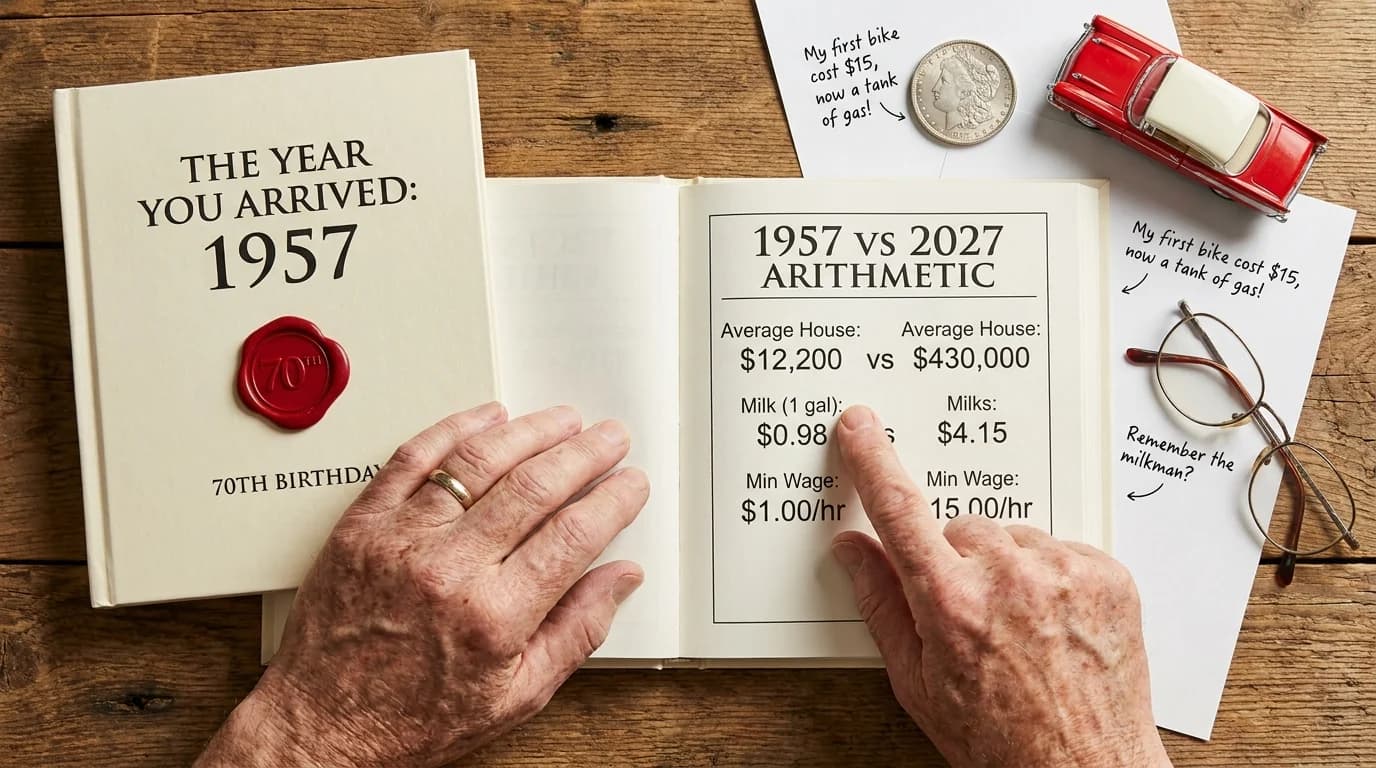
“You do not remember 1957. You were a baby. That is the reason this book exists, and it is the reason it is built the way it is. The first part tells you about the world you arrived into, because you were there and cannot recall a minute of it. The second part is about the years you do remember, and it stops explaining and starts asking. The third sets the year you were born beside the year you turn seventy, with the arithmetic done properly.”
Every price cited in this work was read directly from the original 1959 U.S. Bureau of Labor Statistics bulletin, not scraped from greeting card trivia sites. Where internet claims conflict with government ledger records, the actual numbers are presented with the original agency citation.
What Was Life and the Economy Really Like in 1957?
- 1.The Store vs. Doorstep Milk Spread: A quart of whole milk cost 23.4 cents at the grocery store, while home delivery by the neighborhood milkman was 25.2 cents per quart (a 1.8¢ or 7.7% convenience surcharge).
- 2.The 45% Seasonal Egg Spike: Grade A large eggs plunged to 47.9 cents per dozen in June during peak natural laying season, but surged to 69.5 cents per dozen in October as autumn molting set in—a pre-industrial seasonal volatility that modern shoppers never experience.
- 3.Debunked Internet Myths: Homes did not average $12,220 (FHA median new home sales were $14,600). Gas was not 24¢ (national average with tax was 30.79¢). Family income was not $4,550 (median was $4,970, though women working full-time earned just $3,008).
- 4.Tectonic Historic Milestones: CBS filmed Elvis Presley exclusively from the waist up on Jan 6; the 101st Airborne escorted the Little Rock Nine on Sept 25; and the Vanguard TV-3 rocket exploded live on Dec 6—launching a space race that reached the Moon 11 years and 7 months later.
- 5.Milestone Speech Formula: Writing a 70th birthday toast requires calibrating speaking speed (130–150 words per minute). A standard 5-minute tribute requires exactly 650 to 750 words.
1. The Counterfeit Memory: Debunking Three Common 1957 Internet Myths
If you buy a novelty greeting card or browse a generic “Born in 1957” web page, you will encounter the exact same list of figures repeated word for word. Most of them were copied from an unsourced blog in 2004, which in turn copied them from an unverified email chain.
When author Nancy Whitaker cross-referenced these popular claims against the 1959 U.S. Bureau of Labor Statistics (BLS) Bulletin No. 1256 and U.S. Census Bureau Current Population Reports (Series P60, No. 30), three of the most widely repeated numbers fell apart.
“Average House Price: $12,220”
The Real Record: The median price of new one-family houses sold with FHA-insured mortgages in 1957 was $14,600. The $12,220 figure was a deflated aggregate that included rural structures lacking indoor plumbing. In booming postwar suburbs like Levittown or California tract developments, purchasing a three-bedroom ranch required substantially higher financial outlays.
“Gasoline was 24 Cents a Gallon”
The Real Record: The BLS retail fuel survey recorded the nationwide average price of regular leaded gasoline at 30.79 cents per gallon in 1957, once federal (3¢) and state excise taxes were included. The 24¢ claim represented temporary, localized “gas wars” between independent stations, not the actual pump price families paid across the country.
“Average Annual Salary: $4,550”
The Real Record: Census Bureau Series P60-30 documented that median family income in 1957 was $4,970 (up 4% from 1956). Crucially, the generic figure hides the gender divide: individual median income for men working year-round full-time was $4,713, whereas for women working full-time it was just $3,008.

2. The 1959 BLS Ledger: Milk, Eggs & The Arithmetic of Turning 70
When you turn seventy, everyone wants to tell you that everything was cheaper in the year you were born. That is bad arithmetic. Things were not just cheaper; the relationship between labor, technology, and convenience was fundamentally distinct.
The Milkman's Convenience Premium: 23.4¢ vs. 25.2¢
In 1957, American households were caught between two distribution eras: the neighborhood dairy delivery truck and the modern supermarket dairy case.
BLS Bulletin No. 1256 tracked both channels meticulously. A quart of whole fresh milk purchased in glass bottles or waxed cartons at the grocery store cost an average of 23.4 cents. If the milkman delivered that identical quart to your front porch insulated aluminum box, the price was 25.2 cents. That 1.8-cent difference was an intentional 7.7% surcharge for doorstep service—a price millions of young mothers with toddlers gladly paid.
The Great 1957 Egg Mystery: Why June Eggs Were 47.9¢ and October Eggs Were 69.5¢
Modern shoppers walk into an air-conditioned grocery store in February or July and expect egg prices to stay steady. In 1957, eggs experienced violent, predictable seasonal cycles:
- • June 1957 (47.9¢ per dozen): Spring warmth and extended natural daylight triggered peak hen laying cycles nationwide. Egg supplies flooded the market, pushing wholesale and retail prices to their annual nadir.
- • October 1957 (69.5¢ per dozen): As autumn days shortened, older flocks went into molt and stopped laying, while the spring pullets were not yet at peak maturity. Total egg volume collapsed across the Midwest and South, triggering an abrupt 45.1% price surge in just four months.
Source: U.S. Department of Agriculture (USDA) Agricultural Marketing Service, “Egg and Poultry Monthly Retail Averages, 1957–1958.”
The 1957 vs. 2027 Price Comparison Ledger
Here is what actual daily commodities cost in the year you arrived, alongside their modern equivalents and the hours of work required to earn them based on prevailing wages:
| Commodity / Expense | 1957 Nominal Price | 1957 Work Time (Avg Wage: $2.05/hr) | 1959 BLS Bulletin Ref |
|---|---|---|---|
| Quart of Milk (Store) | 23.4¢ | 6.8 minutes of labor | BLS Bull. 1256, Table A-2 |
| Quart of Milk (Milkman Delivery) | 25.2¢ | 7.4 minutes of labor | BLS Bull. 1256, Table A-2 |
| Dozen Eggs (Grade A Large, June) | 47.9¢ | 14.0 minutes of labor | USDA AMS Retail Series |
| Dozen Eggs (Grade A Large, October) | 69.5¢ | 20.3 minutes of labor | USDA AMS Retail Series |
| Pound of Round Steak | 93.6¢ | 27.4 minutes of labor | BLS Retail Food Prices |
| Loaf of White Bread (1 lb) | 18.8¢ | 5.5 minutes of labor | BLS Bull. 1256, Table A-1 |
| First-Class Postage Stamp | 3.0¢ | 52 seconds of labor | USPS Historic Rate Records |
| Movie Theater Ticket | 55.0¢ | 16.1 minutes of labor | Motion Picture Assoc. 1957 |
| New Chevrolet Bel Air 4-Door | $2,238.00 | 1,091 hours (27.2 weeks) | General Motors Invoice MSRP |

3. The Headlines of 1957: The World You Arrived Into
When a baby is born, parents are preoccupied with feeding schedules, laundry lines, and colic. Meanwhile, outside the nursery window, the 20th century was undergoing profound cultural and geopolitical transformations.
The Night CBS Filmed Elvis Presley from the Waist Up
On his third and final appearance on The Ed Sullivan Show, CBS executives were in a panic over the moral panic sweeping middle-class living rooms. Network censors issued a strict edict to the camera operators: Presley could only be shown from the belt upward. While Elvis sang “Peace in the Valley” and “Hound Dog,” 47 million viewers watched a tightly cropped frame that became a legendary testament to postwar generational tension.
Nine Teenagers Walk Into School Behind the 101st Airborne
Three weeks after Arkansas Governor Orval Faubus used the state National Guard to block nine African American students from entering Little Rock Central High School, President Dwight D. Eisenhower federalized the Arkansas Guard and deployed 1,200 soldiers of the 101st Airborne Division. On the morning of September 25, bayonets drawn and helmets strapped, the soldiers escorted Minnijean Brown, Elizabeth Eckford, and seven other teenagers up the school steps—establishing the federal government's constitutional supremacy in enforcing Brown v. Board of Education.
Sputnik 1 and the Four-Foot Exploding Rocket
On October 4, the Soviet Union launched Sputnik 1, an 83.6-kilogram metal sphere whose repetitive radio beeps triggered immediate strategic anxiety across North America. Eager to demonstrate technological parity, the United States rushed its civilian Vanguard rocket program into prime-time television.
On December 6, 1957, at Cape Canaveral, Vanguard TV-3 ignited on live national television. The rocket rose exactly four feet into the air. Two seconds later, thrust decayed; the booster sank back onto the launch stand, ruptured its fuel tanks, and exploded into a catastrophic ball of fire. The satellite payload was thrown clear, rolling into the brush, where its tiny transmitter was still faithfully beeping.
4. From Vanguard to Apollo 11: The Eleven-Year, Seven-Month Arc
One of the most breathtaking chapters in The Year You Arrived: 1957 examines the incredible velocity of human achievement during the exact years a 1957 baby was growing up.
The Arithmetic of the Moon Landing: 11 Years, 7 Months, 14 Days
Consider the timeline: On December 6, 1957, the world laughed at America's “Flopnik” as Vanguard TV-3 rose 48 inches and collapsed in flames.
Exactly 11 years, 7 months, and 14 days later, on July 20, 1969, a child born in late 1957 was eleven years old, sitting on the living room carpet in front of a black-and-white television, watching Neil Armstrong set foot on the lunar dust of the Sea of Tranquility.
No generation in human history witnessed a more drastic compression of technological progress during their childhood than those born in 1957.
5. What the Archives Cannot Hold: Sunday Kitchens & The Blank Pages
Government archives in Washington, D.C., hold thousands of cubic feet of microfilm recording 1957 steel production quotas, wholesale butter tariffs, and Supreme Court dockets.
Yet, as author Nancy Whitaker poignantly notes:
“The archives do not hold what your kitchen smelled like on a Sunday. They don't know the sound of the wooden screen door slapping shut in August, the names of the dogs that slept on the porch, or the exact words your father said when he turned the car engine off in the driveway.”
This insight explains why the second half of The Year You Arrived: 1957 ceases explaining and begins asking questions. It includes deliberate blank pages for personal handwriting. When families give this book for a 70th birthday, the true value emerges when grandparents, adult children, and grandchildren sit together with a pen to write down the unrecorded memories before they fade.

6. Speech Math: How Many Words for a 70th Birthday Toast?
Whether you are an adult child honoring your mother or father, a lifelong spouse raising a glass, or a best friend addressing a banquet room, giving a 70th birthday toast is an emotional balancing act.
The number one mistake speakers make is failing to calculate their speaking time. A speech delivered too quickly feels rushed and impersonal; a speech that rambles on for 12 minutes causes guests to lose focus.
⏱️ The Golden Rule of Speech Timing (130–150 WPM)
In formal or emotional public speaking, natural pacing averages 130 to 140 words per minute, allowing room for laughter, pauses, and audience reaction:
Ideal for casual restaurant dinners and opening champagne toasts.
The golden standard for family banquets, sharing 2–3 vivid anecdotes.
Reserved for slideshow presentations, lifetime achievement summaries.
A 3-Part Speech Structure Built Around 1957
If you are drafting a tribute for someone born in 1957, borrow the three-act structure Nancy Whitaker used in the book:
- Act 1: The World They Arrived Into (~150 words): Open with a gentle contrast: “In 1957, milk was 23 cents, Elvis was filmed from the waist up, and a four-foot rocket blew up at Cape Canaveral. You were asleep in a crib, completely unaware of the world waiting for you.”
- Act 2: The Years They Built (~400 words): Share two specific, unrecorded personal stories—the Sunday dinners, the advice given during a difficult moment, the traditions they created.
- Act 3: The Arithmetic of Turning 70 (~150 words): Raise the toast: “Seventy years later, we don't count the years by the price of milk or the date of a newspaper. We count them by the warmth in this room and the family you built. Happy 70th Birthday.”
The Year You Arrived: 1957 by Nancy Whitaker
Written specifically as an archival and personal keepsake for individuals celebrating their 70th milestone birthday, this volume features large print formatting throughout for effortless reading, a comprehensive month-by-month news almanac, authentic 1959 BLS government price tables, and guided personal memory prompts.
Explore Our In-Depth Legal, Financial & Writing Guides:
- →Building modern digital wealth and solo leverage? Discover our operator playbook: The Unfair Solopreneur: Compete With Companies 100x Your Size Using AI.
- →Approaching retirement deadlines? Read our comprehensive breakdown: The Year You Retire: Critical Dates, Rules & Benefits Nobody Hands You (2026 Guide).
- →Trimming sentimental or biographical speeches? Learn editorial pruning techniques: How to Cut Your Word Count: 14 Practical Strategies.
- →Mastering long-form content length: Benchmark your articles against our industry analysis: How Many Words Should a Blog Post Be? (2026 Benchmarks).
Frequently Asked Questions About 1957 & Milestone 70th Birthdays
How much did a quart of milk really cost in 1957?
According to official 1959 U.S. Bureau of Labor Statistics (BLS Bulletin No. 1256), a quart of fresh whole milk cost an average of 23.4 cents at retail grocery stores, while doorstep delivery by a milkman cost 25.2 cents per quart—a 7.7% surcharge for delivery convenience.
Why did egg prices fluctuate so drastically in 1957?
In 1957, egg production followed natural biology rather than climate-controlled indoor factory lighting. Spring daylight brought peak laying (driving prices down to 47.9 cents in June), while autumn molting cut supplies dramatically, causing prices to leap 45% to 69.5 cents per dozen in October.
What are three commonly circulated price myths about 1957?
First, the myth that homes cost $12,220 (FHA median new home sales were $14,600). Second, that gasoline was 24 cents (the national BLS average with tax was 30.79 cents). Third, that family salaries averaged $4,550 (the Census Bureau median family income was $4,970, though women full-time workers earned a median of only $3,008).
What happened on live television on December 6, 1957?
America attempted its first satellite launch with Vanguard TV-3. The rocket rose four feet, lost thrust, sank back, and burst into flames on live TV. Exactly 11 years and 7 months later, Apollo 11 landed Neil Armstrong and Buzz Aldrin on the Moon.
How many words should a 70th birthday toast be?
At a natural conversational speaking rate of 130 to 150 words per minute, a 3-minute toast is 390 to 450 words, while a full 5-minute family tribute speech should be 650 to 750 words. Use our Reading Time Calculator to test your draft timing.
Why are blank pages included in The Year You Arrived: 1957?
Government archives document commodity prices and national headlines, but they have no record of Sunday kitchen memories, porch conversations, or personal traditions. The blank pages invite families to document their own oral histories.
Continue Exploring Milestone Guides & Writing Tools
The Unfair Solopreneur: Compete With Companies 100x Your Size Using AI
You are not the underdog. Learn the 5 structural moats—Speed, Trust, Focus, Intimacy, and Firepower—that enterprise giants cannot copy, backed by Gallup and Census research.
25 min read
The Year You Retire: Critical Dates, Rules & Benefits for Women (2026 Guide)
The day you retire, a set of deadlines starts running. Master the 8-month Medicare Part B window, widow survivor FRA tables, the earnings test myth, and Form SSA-44.
22 min read
Best WordPress Hosting for Content Creators in 2026: Honest Comparison
We compared 5 top WordPress hosts — Kinsta, WP Engine, SiteGround, Cloudways, and Bluehost — from a content creator's perspective.
18 min read
Kinsta vs SiteGround 2026: Which WordPress Hosting Wins for Bloggers?
Kinsta and SiteGround both run on Google Cloud — but the differences in performance, support depth, and included features are significant.
14 min read
10 Worth-It Prime Day Apple Deals: MacBooks, iPads & Accessories
Check out these worth-it Prime Day deals on Apple gear, from MacBooks to AirPods. Expert-verified savings with 12-month price tracking.
32 min read